|
Frequently
Asked Questions
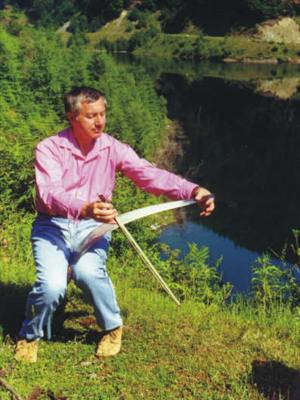
Question 1: Is it a special saw or an ordinary one?
Answer 1: In principle any ‘cross-cut’ saw can be used to play music, but its likely range will be only around one and a half octaves. In order to play as many songs as possible, the saw must have a range of at least two octaves. That is why the musical saws have a special design: the blade is longer and thinner than that of the usual ‘cross-cuts'.
Question 2: Where are you from ?
Answer 2: Sometimes I say, joking, that I am from the United States of… Romania. There is some truth in this joke. A few centuries ago (during the feudalism), the actual Romania appeared as three principalities: Wallachia (The Romanian Country) in the South, Transylvania in the North-West and Moldavia in the North-East. Wallachia was under the Turkish Empire several times during the second millennium and Transylvania was under the Austro-Hungarian Empire. During the 15th and 16th centuries two voivodes of note can be mentioned due to their fame in the battles against the Turks: Vlad The Impaler (called ‘Dracula’) as a voivode of Valahia, and Stefan The Great as a voivode of Moldavia. Vlad The Impaler has remained in the history as a very righteous voivode (due to his fame, ‘Dracula’ is, the second most popular movie hero after Sherlock Holmes). Stefan The Great was a winner in all 37 battles against the Turks. After each victory he ordered a monastery to be built in Moldavia - all these monasteries are now historical monuments. The first Union of the three principalities was achieved, for a short period of only three months, in 1600 by king Michael The Brave. Unfortunately he was killed due to his courage. The second Union of Muntenia and Moldavia was done in 1859 when Alexandru Ioan Cuza was elected as a king of both Moldavia and the Romanian Country, and so appeared the modern Romanian national state. In 1918, at the end of the first world war, Transylvania proclaimed its Union with Romania, creating the Unitary Romanian national state. This is a very short history of Romania.
Question 3: How did you get the idea of playing this instrument?
Answer 3: Here is a short story. When I was a small boy I heard someone playing a saw on the radio. I kept that beautiful sound in my mind and my soul for many years. In 1981 I participated at a festival in Eastern Berlin. Among the participants was a group from Sweden, one of the group was playing a musical saw. Then I decided to buy a musical saw and to start practising as soon as possible. The right moment arrived in the autumn of 1982. One evening I discovered in a newspaper someone wishing to sell a musical saw. The seller put me in touch with a person playing this instrument. That player showed me how to start. In 1983 I was able to record on the saw my first song in the studio of the Romanian Television. Then followed a long period of practice when I discovered by myself other secrets of the instrument and I enlarged my repertoire. Now I can play on the saw more than 100 tunes!
Question 4: Is it difficult to play?
Answer 4: Yes, it is. First of all, to become a good musical saw player it is necessary to have a perfect musical ear. Some musical saw players say that it is of merit to try to see if you are able to whistle or hum correctly any melody. Beyond this, a lot of practice is needed to be able to play ‘on pitch’ and without any bow noise. And, a fact valid for playing any other instrument, the most difficult thing is to be able to play with feeling (that is to put heart into your playing).
Question 5: Are there different styles in playing the musical saw ?
Answer 5: Yes. It depends on how you start. In general the playing techniques can be divided in two categories: standing up and sitting down styles. In all cases the saw blade must be kept always tensioned (like a slight S). Most players catch the end of the blade with the four fingers (the forefinger, the middle finger, the ring finger and the little finger) and press the blade on the other side with the thumb. Some other players use a special tool called ‘top grip’ to bend the blade. To bow the edge of the blade you may try the down-up direction, the up-down direction or both directions. In order to get the ‘vibrato’ effect some players oscillate in a vertical plane one of their knees, others obtain this effect from the wrist. Usually the saw is kept with the handle between the knees and with the teeth pointing towards the player’s body while bowing the blade on the other side. There are some players (very few) keeping the blade with the teeth opposite to the body and bowing the edge of the blade in the space between this and the body.
|